Health
If You’ve Heard Wearing a Face Mask Can Give You a Sore Throat, You Need To Read This
We asked an expert for the lowdown.

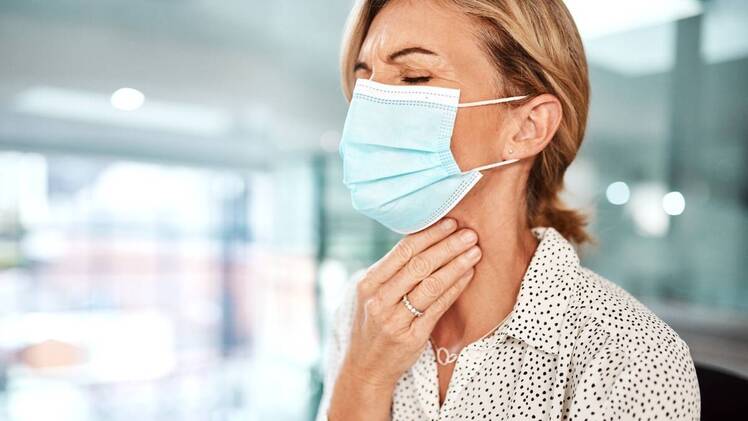
Though mask mandates across the country are being lifted, many Americans will continue to wear masks. Some people may be immunocompromised or concerned about spreading COVID-19 to vulnerable friends and relatives. Or they may work in a healthcare facility. Regardless of the reason, those who still wear masks must deal with certain discomforts, including foggy glasses and face acne (“mascne”). Some people have even complained that wearing a face mask gives them a sore throat.
But is this claim true? We sat down with Donna A. Patterson, PhD, global health researcher, professor, and department chair at Delaware State University, and Sachin Nagrani, MD, Medical Director at Heal, to find out.
Can wearing a mask cause a sore throat?
“In regular day-to-day activities, a mask really shouldn’t cause a sore throat,” says Patterson. “Some exceptions might include if someone projects for long periods of time and strains their vocal cords. However, this also depends on the type of mask. It [may be] easier to project one’s voice with a KN95 mask than a surgical mask, for instance. Other reasons could be that the person has an existing respiratory illness or an allergy that causes a sore throat.”
Dr. Nagrani believes it’s possible that a well-worn mask can cause some throat scratchiness. “When wearing a mask for extended periods of time, the warmth, humidity, and any irritants or pathogens on the inside of the mask if not cleaned can potentially cause a temporary sore throat,” says Nagrani.
A 2012 study from Respiratory Physiology and Neurobiology, for instance, found that wearing a surgical mask while exercising created a pocket of “dead space,” or dead airspace inside the mask that made breathing uncomfortable (but not impossible). This could cause discomfort in the nose and throat. However, more evidence is necessary to back up this claim.
To avoid discomfort, switch your mask regularly.
If you’re experiencing any sort of discomfort from your mask, try swapping it out for a new one more frequently. Disposable masks like N95s, KN95s, and KF94s that are damp, dirty, or have a smell should be thrown away.
“The inside mask will collect particles as you breath through it, and switching out an N95 or surgical mask ensures that you have a clean surface,” says Nagrani. “This reduces the risk of skin irritation from prolonged contact to an unclean surface, and respiratory tract issues from the collected particles such as causing a sore throat.”
“It is important to switch out a mask to reduce the risk of wearing a mask that could be contaminated with COVID-19, influenza, or other viruses,” adds Patterson. “Masks can also become soiled from makeup, sweat, saliva and other substances. Yes, masks can cause acne, too, and extra oil build up or other irritants can contribute to this happening.”
How often should you change your mask?
“The Centers for Disease Control (CDC) recommends throwing away disposable masks after they’ve been worn once or if they become wet or dirty,” Nagrani says. “While replacing a mask after each use makes sense in clinical settings, in public use it may not be reasonable or cost effective to throw out a mask after a one-time use after a few minutes. There’s no specific rule and it’s a function of how long the mask is worn before replacement; it’s reasonable to replace a mask after a single prolonged use or repeated short term uses.
“This refers to surgical, KN95, N95, KF95, and other medical grade masks. Cloth masks can be washed to keep them clean between uses, but it is recommended to use a medical grade mask because they offer superior protection.”
“I suggest changing or washing your mask daily,” Patterson adds. “Generally, face masks were for one-time use prior to this pandemic. Most of the boxes will say that they are disposable — except, of course, cloth masks. These can be washed and reused. I strongly recommend that people do not reuse surgical masks.” For more help, check out these tips for properly sanitizing your masks.
The bottom line? Wearing a mask may cause a sore or scratchy throat, but it’s not likely. It can also cause other discomforts. By rotating your masks daily and sanitizing them frequently, you’ll avoid a lot of discomfort and mask fatigue!